Dear Friends:
As the year comes to a close, we are faced with new challenges. Change is an inevitable aspect of life, and as we face these new challenges we must adapt to their demands of us.
John F. Kennedy once said, "Change is the law of life. And those who look only to the past or the present are certain to miss the future."
I am assured that all of you - our participants, our staff, and our friends and partners - will make the transitions necessary to adapt and succeed in your new and continued endeavors. We have worked hard to build the skills and gather the resources necessary to ease us into whichever transitions we may each face.
As we move forward, I am certain that we will all succeed in our respective new and continued exciting adventures. Each of you has inspired me uniquely. Thank you for teaching me as I have taught you.
To the future!
Hector Zambrana
Wednesday, June 13, 2007

Tuesday, April 24, 2007
Computer Literacy--Using Microsoft Publisher 2000
Sure, your Blogger page may look good, but have you ever tried to put something together from scratch that is visually pleasing to behold?
Today's topic is desktop publishing (DTP). Desktop publishing has to do with the creation of documents like fliers, newsletters, and webpages on a personal computer. There are many programs that will allow you to do desktop publishing; today, we will be using one of these to create a document.
The Assignment
Today, we will be using Microsoft Publisher 2000 to create a short newsletter from scratch. We will not be focusing on doing much with the words in our newsletters unless we have time at the end of our lesson, but even just with the design, there is still a lot to cover in only a short amount of time.
Here are a list of web resources we can reference as we create our documents today.
Today's topic is desktop publishing (DTP). Desktop publishing has to do with the creation of documents like fliers, newsletters, and webpages on a personal computer. There are many programs that will allow you to do desktop publishing; today, we will be using one of these to create a document.
The Assignment
Today, we will be using Microsoft Publisher 2000 to create a short newsletter from scratch. We will not be focusing on doing much with the words in our newsletters unless we have time at the end of our lesson, but even just with the design, there is still a lot to cover in only a short amount of time.
Here are a list of web resources we can reference as we create our documents today.
Tuesday, April 17, 2007
Today’s Computer Literacy Lesson

Objectives: (1) To re-familiarize ourselves with blogging. (2) To create an appealing ad that shows off our best, most work-appropriate face!
Terms: Blogging, Font Style, Picture Format
Getting Started: Advertisements are everywhere. You probably passed ten on your way to First Work today. Some you noticed, others you may have power-walked past without batting an eye. Here are some questions to help us focus on what today will be about:
- Think about one of the ads you can remember seeing today or in the recent past. (If one doesn't readily come to mind, choose one of the two provided below.) What was it about the ad that made you notice it?
- Did it appeal to your interests? If so, which ones? Why are these appealing for you?
Did the ad you picked advertise something you were looking to buy? Did this have an impact on the ad’s effectiveness on you? - How would you describe the ad's presentation? (Think about use of lines, colors, pictures, etc.) What is the role of presentation in the ad’s overall impact?
Examples of


How you advertise yourself
In the same way as we see only the ads that appeal to us, interviewers and job recruiters will pass up all the candidates that don't show them an image that they want to see. This doesn't mean that if you're not a certain type of person from birth that you have zero chances of ever getting a job you want. What this means is that, instead, we must do a few things when we are serious about work.
- (Interpret) First, we need to think about your potential employer and think from his/her perspective. (Who are you trying to work for, and what are they looking for? Read into the want ad or the company and make your best guess as to what they really want.)
- (Reflect) Next, find the things inside you that match the image of what your potential employer wants to see--and bring that to the surface; focus on all the things that prove that you are an exact match. (Does your employer want someone who is responsible? Then focus on all the times you showed this and bring this aspect to the foreground. Does your employer want someone who is good with math? Focus on the times where you have proven that this, indeed, is you!)
- (Apply) Most importantly, learn to recognize where you cannot match the image of what an employer wants and act on it. (Maybe you are thinking of applying to a challenging job in public relations and don’t feel that you have enough experience in speaking to do the public speaking part well. This might mean that you decide to get some more experience before you seriously try for the job, that you decide to practice speaking with strangers, or it may mean that you need to try to find a job that better matches your needs. It’s not about being pessimistic here; it’s about being realistic!)
Today's Assignment
Moving onto today's assignment, read over these three job descriptions listed below.
*******************************
Seeking F/T security guard for high vol
clothing store in Mid- town Manhttn.
Benefits incl. Call Steve 917 XXX XXXX
*******************************
Wanted: P/T sales rep for a small internet
company. No exp req'd, but must be willing
to travel. 212 XXX XXXX.
*******************************
Seeking PT/FT wait staff for small family diner
on Upper West Side. Prev exp prefrd. Call Maria
212 XXX XXXX.
*******************************
Pick one of these three to try to "apply to" follow the following procedure.
A) Go through the three steps (Interpret-Reflect-Apply) listed above for your chosen ad, and make a list of things your employer would want, things that you can show in your experience, and things that you may need to work on for that particular job. Discuss your lists in groups. Is everyone in agreement? Did you perhaps miss anything that would be a necessary skill for your job? Did someone suggest something that you hadn't thought about? Add that to your list.
(This is the fun part:)
B) Brainstorm a posed picture of yourself that shows all those aspects that you just discussed in your group. This picture should convey something, not just show your pearliest smile. Be creative!
C) Log onto your First Work blogs and import your picture into a "sales ad" entry selling yourself! I will be around to explain how to go about this, during session, but don't be afraid to use each other as resources, too!
Links to Student “Self-Ads”:
Friday, February 16, 2007
MIYB 4 (2 Week Countdown)
Tuesday, February 13, 2007
Marvin's Internet Scavenging Puzzle

Scenario:
My best friend managed to get me tickets for a Broadway musical. (I love Broadway musicals!) I, however, am a complete Forgetful Jones when it comes to details and I cannot--for the life of me--remember the name of the theater or even the musical. The show starts in 45 minutes, and all I can remember is that it's supposed to be like the prequel to "The Wizard of Oz." Can you find the theater, AND transportation directions from the Harbor? (1 East 104th Street, New York, NY 10029)
My best friend managed to get me tickets for a Broadway musical. (I love Broadway musicals!) I, however, am a complete Forgetful Jones when it comes to details and I cannot--for the life of me--remember the name of the theater or even the musical. The show starts in 45 minutes, and all I can remember is that it's supposed to be like the prequel to "The Wizard of Oz." Can you find the theater, AND transportation directions from the Harbor? (1 East 104th Street, New York, NY 10029)
(Workshop) Searching the Internet


*************************************
The internet is a remarkable tool that you can readily use to sort through and retrieve information from around the globe. Websites today come with all sizes and types of files, and many of the more popular sites--like YouTube and MySpace--are updated hundreds of times daily. These means that when you logon to these sites, you are likely to find up-to-date information; however, when you don't know exactly where to go, the fact that these sites are updated so regularly can be a problem for someone trying to search through what's out there right now.
*************************************


Here are some questions we will ask ourselves today:
- How do we search the internet for information?
- When we look online, do we rely only on one site like Yahoo! or Google to find information on the web?
- Do we use special functions or symbols to help with our searching? What are the special functions/symbols we can use?
- What other tools are out there?
Tuesday, February 06, 2007
Completing the Cover Letter


Today, at First Work, we will be working to complete the cover letters that we began last week. Linked to this blog entry are two worksheets that we will use to check over our cover letters as we ready them for sending.
Students who have completed and blogged their cover letters as of 02/06/07: Krystal, John, and Tiffany.
(NOTE: Students wrote these, their first cover letters, as a future version of themselves, post training. As part of their First Work internships, however, students will need to complete a cover letter that is written from their current experience and speaks to their immediate goal of acquiring an internship position.)
Students who have completed and blogged their cover letters as of 02/06/07: Krystal, John, and Tiffany.
(NOTE: Students wrote these, their first cover letters, as a future version of themselves, post training. As part of their First Work internships, however, students will need to complete a cover letter that is written from their current experience and speaks to their immediate goal of acquiring an internship position.)
Thursday, February 01, 2007
Creating an Individual Employment Plan
Today we will be working on putting together individual employment plans (IEPs) that will lay out for us our work goals and ways to get there.
The IEP will be broken up into three main components:
The IEP will be broken up into three main components:
- History (Job, Work, Education, etc.)
- Skills/Needs (Personal Budgets, a List of Marketable Skills, a List of Services Sought)
- Goals/Plans (Future Goals and Milestones, Methods of Attaining these Goals)
Tuesday, January 30, 2007
Creating a Cover Letter

When you look at the image to the left, what do you see? Do you see someone hard at work? A normal day at the office? Or perhaps the perfect picture you'd want to show a potential employer?
Today, we will undertake the task of creating cover letters--self-advertisements for your potential employers that will let them know instantly that they needed to have you in for an interview--yesterday.
The cover letter, which traditionally accompanies your resume is sometimes the only chance you have to make an employer an offer s/he can't refuse. The way we'll think about our cover letter today is as a self-advertisement in written form with three parts:
- An Introduction
- A Sales Pitch
- A Call to Action
Monday, January 29, 2007
(Workshop) Job Searching on the Internet

When you're traveling the
Information Superhighway,
are you in hyperspeed or
the slow lane?
Last week, we reviewed using the newspaper and telephone as a way to find and research jobs. In a similar way, the internet can serve as a very useful way to search and find job openings; however, many people can get mired in the large number of search results they may find.
To make the most of our internet job hunting, there are a few pointers to take into account first. Otherwise, rather than zooming to your express exit on the information superhighway, you could end up winding along a long and uneventful detour route.
Basics of Job Searching
As we learned last week, there are a few basic things that you can do to take hold of your job hunting. The first is to know what you are looking for.
Knowing what you are looking for means more than having a salary-range in mind for a position. It means knowing what you'd be willing to do for how much, where, when, and for how long. Because when we use the internet, we are able to search through want ads based on the things we want out of a job, and to save time and energy, we should do just this so that we get straight to the jobs that apply to us and avoid dud search results.
Below is a listing of some excellent web resources for web-based job hunting. Some of the sites, including the New York Job Bank, allow you to input resume data and use these resumes to narrow down searches to jobs that appeal to your resume. The NYJB also allows you to create a "Job Scout" that will check the listings on a schedule and email you results that respond to your criteria.
New York State Job Bank (Lots of great search options)
New York State Department of Labor Site (Links to many job-related sites)
Not-for-Profit Job Listings (Lots of work, but many are not entry-level)
About Craigslist
Craigslist is another great search engine for jobs that will be even more specific to part-time or temporary work in the New York City area, but because this engine is not regulated, anyone can put a posting for anything online. Because of this, the people who are in charge of Craigslist stress that it is important for users to exercise extreme judgement when making any communication online. Many of the same things to watch for when we use the classified pages in the newspaper apply to when we use Craigslist. To summarize:
- Never trust a potential employer that expects you to pay for training.
This is a common trap that pyramid-schemes use to get money. They claim that you'd be perfect for their organizations, often without knowing much more about you than your name and age. Any real job wouldn't have you pay for anything but your uniform. - Never respond to a want ad that sounds more like an advertisement or infomercial.
This is a sure-fire sign of a money trap. - Never respond to a want ad that is not clear about the job offered.
- Don't get duped by "modeling/talent agencies."
They make most of their money from training/head-shot fees.
Keeping these in mind, Craigslist, too, is a great resource for those with the time and patience to sift through lots of dirt for a jem of a job.
Friday, January 26, 2007
(MIYB) The Fundraiser--Part I

The next few weeks of Make It Your Business (MIYB) Fridays will be very different from the projects we have tackled until now. Through the next few weeks' worth of blood, sweat, and tears, you will create and run your own businesses in a week of fundraising frenzy! Even better, you will be able to earn a group jackpot towards your clothing stipend accounts.
The Project
1) Today you will break down into groups of 2-3 people and spend about 20-30 minutes deciding what your fundraising "business" will be. You have a choice of doing any of the following three choices:
- Creating a fundraising pizzaria
- Creating a Valentine's gift/photo shop
- Creating a lunch catering business
2) Once you have your ideas ironed out for your businesses, you will need to come up with a list of all the supplies you need. The less supplies your business has to purchase, the better for your team's ability to raise and earn money. Once you have a complete list for your business, you need to come up with a list of prices of the items/services you will sell. Using this, we will calculate your break even point, or BEP (the point where you've earned the money you spent out for supplies).
For the purposes of our project, this number (the number of products you have to sell to break even is determined by the following formula:- BEP = (total costs for supplies) ÷ (price of most popular products/services)
3) Lastly, for the remainder of your time today, you are to write a one paragraph summary of your chosen fundraising idea that you can include as your cover sheet for the work to follow in the next few weeks. Briefly name your group members, describe your idea, and choose two dates in February that all group members (or the majority) can agree to meet. (The fundraiser day for your group will only be on one of those days.)
Summary
Today's project is the first in a series of four MIYB project days. You will keep the same groups for all days, and groups are small, so it is important that everybody maintain good project attendance for the next few weeks. Also, all stipend money that is raised for the group will be split by group decision, so unproductive members beware!
By 6:00 today, you are to (1) meet with your group; (2) decide on a fundraising business idea; (3) come up with a supply, cost, and price list, and complete the worksheet; (4) determine your BEP; and (5) write up a fundraiser proposal sheet describing your project idea, members, and proposed date.
Tuesday, January 23, 2007
(Workshop) Proofreading for Letter Writing

Writing is not easy. It takes lots of focus, determination, and practice to get something to come out sounding right. And usually, even if something you wrote makes sense, a little proofreading and re-writing is necessary to produce something you can be proud of.
Today we will focus on writing business letters, spotting errors in our writing, and making suggestions for revision. While the rewriting process can seem difficult if we try to do everything all at once, there are basically three things we look at when we revise something. These are listed below:
Today we will focus on writing business letters, spotting errors in our writing, and making suggestions for revision. While the rewriting process can seem difficult if we try to do everything all at once, there are basically three things we look at when we revise something. These are listed below:

- The way you present your writing on paper (Style)
Style describes how your writing looks to someone reading it. For example, if you’re writing a letter, you might ask the following questions about your style: Is the date in the right spot? Are the paragraphs indented? Is the return address in the traditional spot?
Style is probably the easiest thing to check and correct. There are many resources in the First Work office that you can use to check your style, and you may also check your style using word processing programs like Microsoft Word. - The way you put words and sentences together (Mechanics)
Mechanics deals with all the writing rules you learned in school like spelling and grammar. Many of these things you can check using computer programs like Microsoft Word. - The way you express your ideas (Rhetoric)
Rhetoric is how you put down your ideas into words. For example, think about having to ask a friend to borrow $50. There are some ways that you can say this that would be successful and other ways that would get you a dirty look at best. Rhetoric is how you choose your words carefully to best get across your point with the desired effect. This is the hardest thing to revise because there's no set rules for how to word things.


Friday, December 15, 2006
First Work Program Year-In-Review: 2006
This week at First Work, we celebrated our first full calendar year of service, laughs, and dedication by honoring our participants and staff for achievements made in 2006. Thanks to everyone's continued and growing support, 2006 at First Work was a year memorable for both our strides and stumbles, and perhaps most importantly, for our recoveries.
As a testament to a year's worth of experience, below is the Year-In-Review Video Presentation that was presented at the Awards Banquet.
From everyone at the First Work Program, best wishes for a safe and opportunity-filled New Year!
As a testament to a year's worth of experience, below is the Year-In-Review Video Presentation that was presented at the Awards Banquet.
From everyone at the First Work Program, best wishes for a safe and opportunity-filled New Year!
Friday, October 27, 2006
(Project) MIYB Project 3 - Head of the Class

Two projects ago, we learned about "Concept" as a component of the business plan. By business "Concept," we understand the main idea or set of ideas that describe how a business will achieve its financial goals.
"Concept" is the secret ingredient for a business's success; it answers the very general questions of "How?" and "By doing what?" when it comes to a business attaining its goal.
Here's a metaphor that might help.
A business's goal is like a finish line in a race. It's the place you are trying to get to within a certain time, or before other people get there to win if you're competing against others. But how will you get there? Does your strategy involve racing along the inside track? Holding back until the last minute? And just as important, what will take you to that finish line? Your shoes? Your breakfast? Gasoline?
All of these things that get you there (strategies, energy sources, etc.) work like a business "Concept." It describes specifically not where you are going but how you plan on getting there.
Take the example of a restaurant that serves food in East Harlem. Its goals--like any other business--might be to make a certain amount of money by the end of the year, or to become a household name in the surrounding area within six months. These things are fine goals to have, but they do not count as the business's "Concept." The concept of the business might be to put the customer first, or to sell a certain food that puts them ahead of the competition. These could all be components of the business "Concept" because they are all ways that they are going to succeed in reaching their goals.
Today's Project
Today's project will require you to make presentations to a class of MicroSociety students about what a business "Concept" is and get them to start thinking about what things could qualify as business concepts for the businesses they are building.
You are to go to an assigned room at 4:30 and introduce yourselves to the students in your classroom. Tell them that you are here to introduce an idea that they might find very useful in making up their business plans for their sectors. Then, with permission, present briefly about what a business's "Concept" is and give them a short oral quiz after your presentation.
Your performance today will be determined by the average quiz score of your group. The two highest scoring groups will be awarded $30 FWB toward their clothing stipends.
Tuesday, October 24, 2006
(Workshop) Spending Analysis
When you make a budget for yourself, it can be like we did last week in the Financial Literacy workshop, where we worked to build a budget based on estimations about future spending, or it can be a budget to show past spending. Today at First Work, we will be taking another look at breaking down costs and making a budget in the second way--from the ground up.
You will be given a bunch of receipts showing expenses from May to October for a fictional organization. Your job is to create a spreadsheet in Microsoft Excel to chart the expenses in different categories of spending. First answer the questions below, and then try your hand at sorting and recording.
You will be given a bunch of receipts showing expenses from May to October for a fictional organization. Your job is to create a spreadsheet in Microsoft Excel to chart the expenses in different categories of spending. First answer the questions below, and then try your hand at sorting and recording.
Questions
- What different categories of spending do the purchases seem to fall in? (Are most of the receipts from grocery stores? Are there some amounts spent for other types of purchases?)
- What types of information from the receipts do you think it would be necessary to fill in about the purchases? What information would be okay to omit?
Once you figure out this information, you are ready to start a spreadsheet to record information about the individual items on the reciepts.
Project Add-On
Your boss is pleased with your list, but wants two things added: she wants you to (1) Add a box to show the total spending in each of the categories, and (2) Sort your list by date.
Excel Tips
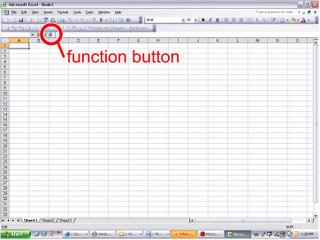
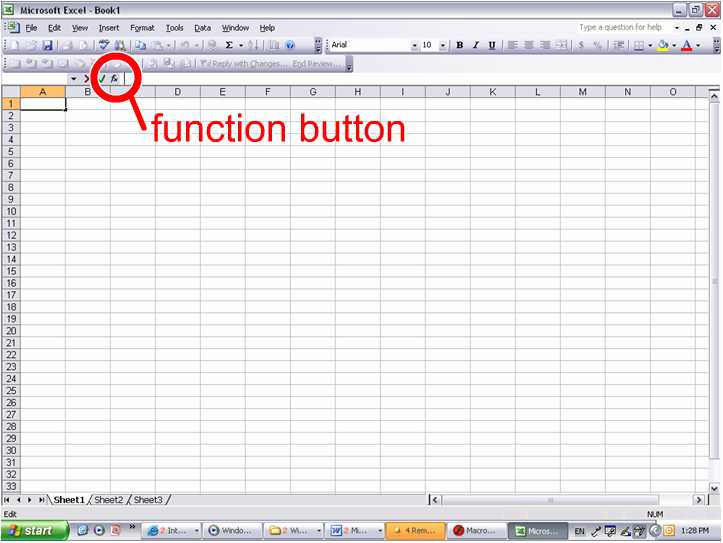
- Remember that you can use functions in Excel to help you when you need to do some math with numbers that are already on the spreadsheet. Your hint with formulas is the location of the function button, as shown below.
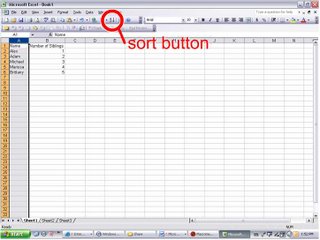
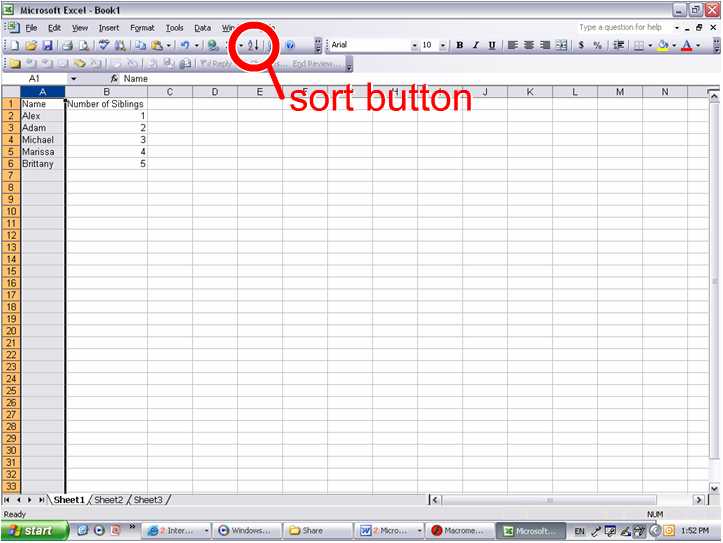
- You can also use Excel to sort information for you automatically with the sort button. To use the sort button, you must first select the items you want to sort. The location of the sort button is shown in the picture below.
Friday, October 13, 2006
(Project) MIYB Project Two: Job Coaching
 The project today will require you to help coach students in the Harbor's afterschool program, Senior Education.
Senior Ed is a program geared toward students aged 8-12 that teaches young students in elementary school about the fundamentals of the real world. As a part of this program, Senior Ed students participate in something called Microsociety, which is a pretend "work-world" that the students maintain. MicroSociety has its own currency, businesses, and workers who have work days and days off. Every student in MicroSociety is either a manager or worker in one of the businesses there, and s/he must interview for any of the positions seeked.
Today is a job fair day for the MicroSociety component of Senior Ed. This means that the students will be interviewing for the different positions that will be available to them in the hopes of landing the MicroSociety job of their dreams.
This is where you come in. The project this week is to:
(1) Work in a group to develop some coaching services that you will offer to MicroSociety students as they wait to be interviewed. The coaching services will be geared to prepare the students in some way for the interviews they will have today. The services you offer should not take more than 5-7 minutes for each student. (Some examples of services can be offering help in completing the MicroSociety job application, conducting a short a mock interview and offering feedback or pointers, or some other service that you decide upon.)
(2) Meet with the MicroSociety students as they wait for their interviews and offer your services to as many students as possible.
(3) Give each of the students you serve an evaluation slip that the student will use to rate your services. (Evaluation slips will be supplied to you.) You do not need to collect these back from the students.
(4) Create a written description of your services to be handed in by the end of the day.
Your groups will be judged based on the ratings they recieve and the completeness of the descriptions you hand in at the end of the day.
Good Luck.
Tuesday, October 10, 2006
Blogging Perspectives/People (Continued)
Blogs, as we have seen last week, can be used in many capacities. A person can use a blog to publish journal entries, thoughts, assignments... The possibilities are limitless. And yet, there is perhaps one thing that remains true for every blog. That is, every blog is a reflection of the blogger.
* * *
* * *
Overview
Today's excercise will require that you (1) complete your Blogger profile, (2) answer the questions below as a post on your blog, (3) comment on each other's blogs, and (4) introduce each other in class.
Directions
Complete your Blogger Profile online. To do this, go to the "Dashboard" and follow the link to edit your profile. Then answer the questions below.
Today's excercise will require that you (1) complete your Blogger profile, (2) answer the questions below as a post on your blog, (3) comment on each other's blogs, and (4) introduce each other in class.
Directions
Complete your Blogger Profile online. To do this, go to the "Dashboard" and follow the link to edit your profile. Then answer the questions below.
Questions
- Is this picture on its side or upside-down? Describe what this is a picture of.

- What do you think the artist of this collage was trying to say? Why do you think that?
- What picture/drawing/work of art best represents your character? (Link to an image of it if possible, or describe it for us.)
- What do you think is going on in the comic strip below. (Feel free to make up characters' lines.



Friday, October 06, 2006
(Project) MIYB: Business Plan Basics
As you have learned in the pre-workshop exercises today, writing a business plan is a big project that starts with good organization and dilligently researched information.
_______________________________________________________

Today's Project:
Today, as your MIYB Project, you will be broken into two or three groups and asked to create a basic business plan according to the criteria we went over earlier today.
Keeping in mind our "Focus Five" sections of the business plan ((1) Business Concept, (2) Future Goals/Past Milestones, (3) Customer/Market Information, (4) Competitor Information, and (5) Products and Services), create a basic business plan for Redken, a New York-based hair product company who won a 2006 Webby Award for website design in the Beauty and Cosmetics category.
Today's winning group members will recieve, individually, $30 toward their clothing bank. The deadline for submissions of business plans is today, at 6:00PM.
Good Luck.
_______________________________________________________
Today's Project:
Today, as your MIYB Project, you will be broken into two or three groups and asked to create a basic business plan according to the criteria we went over earlier today.
Keeping in mind our "Focus Five" sections of the business plan ((1) Business Concept, (2) Future Goals/Past Milestones, (3) Customer/Market Information, (4) Competitor Information, and (5) Products and Services), create a basic business plan for Redken, a New York-based hair product company who won a 2006 Webby Award for website design in the Beauty and Cosmetics category.
Today's winning group members will recieve, individually, $30 toward their clothing bank. The deadline for submissions of business plans is today, at 6:00PM.
Good Luck.
Monday, October 02, 2006
Internet Scavenger Hunt/ Computer Literature Activity
Here is an activity to test your Internet surfing skills! Using the list below, begin to search the Internet for all the items. You must either cut and paste the items on your blogger post or type a link to the item. The person who finds the most or all the items and posts pictures of them or links to them on their blogs, will win. You will be given a time limit of 40 - 45 minutes. In addition to finding the items, you will be given a few questions to answer. Remember to do your best and good luck!
Scavenger List
- A Black Butterfly
- A child catching a ball
- A man in a business suit with a red tie
- Two dogs kissing
- An elephant eating
- A woman with an attitude
- A resume
- The business hours of the Parkchester Library in the Bronx
- The world champion who ate the most hot dogs in 2006
- The current Manhattan Borough President
- The baseball team who won the world series in 1974
- The number of schools listed in the New York City Public School system
- A person who has the same first name as you and their importance
- A black panther
- An Indian tribal symbol
- A baby crying
- A your favorite artist/ actor/ actress or singing group
- An apartment for rent ad
- A credit card advertisement
- A vacation spot
Questions
What item was the most difficult to find? Why?
What was the easiest thing to find? Why?
What item on the list best describes you? Why? (Use poetic devices.)
Saturday, September 23, 2006
(Report) The Mock Interview Project
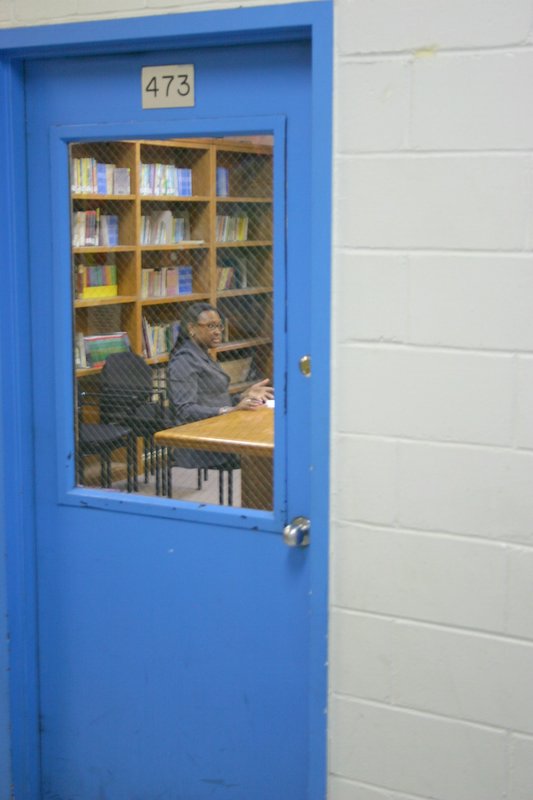
SCENE: A Boys and Girls Harbor hallway on a late August afternoon, muggy, and overcast.
Peeking through the door of room 473, passing Harbor students inquired about "the woman in the pretty suit."
Meanwhile, sitting on the opposite side of the table inside 473, three FW participants donned alter egos one after another and talked about their experiences as a Purple-Heart Marine, a preschool principal, and a former GamePro graphic designer.
Quietly in the corner, a digital camera hummed along, as if to second that this week at First Work was not just business-as-usual.
____________________________________________________
Project Background
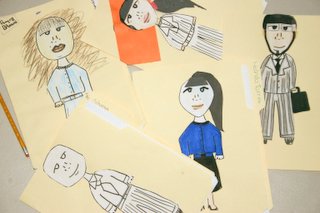
In July, participants at First Work began a workshop series that asked them to consider what it is that makes a good job interview candidate good and put it all down on paper—everything from fictional stories of their character in action to illustrated pictures of their imaginary person.

In the initial stages of developing their characters, participants were asked to consider such things as: What kinds of music do their characters like? What kinds of movies do they watch? What sorts of accomplishments, education, and experience have gone into making these characters the best interviewees possible?
The discussions generated by the month and a half of subsequent character development sparked interesting intrigues into the relationship between one's personal life, demographics, and job marketability. Participants questioned if/how race, personal hobbies, and even one's ability to make difficult, extemporaneous choices affect one's apparent suitability for a position, and how one can present oneself in the best possible light at an interview.
Towards Mock Interviews

The purpose of the July-August character development activities was to set up FW participants for the August Mock Interviews, in which participants would be asked to role play their characters, whose education, experience, and circumstantial were necessary for successful consideration for a position of the participant's choosing.
In this, the overarching aim of the Summer Mock Interviews was to promote and allow the students to demonstrate their understanding of the interpersonal and presentational skills necessary to convince an interviewer that one is the best candidate for a given position, and not to focus on any lack of experience or education that could impede one's chances for the position.
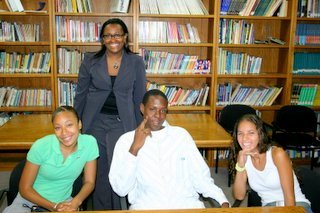
To help with the interviewing, a Human Resources specialist at Chase Manhattan Bank, Ms. T. Lilly, offered her expertise as a fair and impartial interviewer with whom the students were not familiar, and offered the students invaluable advice about sharpening their interviewing skills.
The Mock Interview Project took the place of a MIYB project, and participants who were either recommended by Ms. Lilly for hire or were requested for a second interview achieved passing marks.
"I thought the project today was good," said Caryl as he rounded out his first full week in the program. "It helped me get a better sense of how I interview. I haven't been on that many interviews, so it'll help me do better on [them]."

Subscribe to:
Posts (Atom)

